
The United States immigration system stands as one of the most complex legal frameworks in the world. Each year, millions of people seek to enter, work in, or permanently settle in the country. Navigating immigration laws in USA requires understanding multiple visa categories, green card pathways, and citizenship requirements.
This system affects families, workers, refugees, and students from every corner of the globe. Whether you’re seeking temporary work authorization or permanent residency, the path forward demands clarity and accurate information.
The immigration process can feel overwhelming. Forms pile up, deadlines loom, and one mistake might delay your case for months or even years. Many people spend thousands of dollars on legal fees, unsure if they’re making the right choices.
This comprehensive guide breaks down the United States immigration system into understandable sections. You’ll learn about visa categories, green card options, citizenship requirements, and recent policy changes. More importantly, you’ll discover practical strategies to navigate this system successfully.
Understanding the United States Immigration System
The immigration system in the United States operates under federal law. Congress creates these laws, while agencies like USCIS, ICE, and CBP enforce them. The Immigration and Nationality Act serves as the foundation for all modern immigration policy.
Two main categories define how people enter the country: immigrants and nonimmigrants. Immigrants seek permanent residence, commonly called a green card. Nonimmigrants enter temporarily for specific purposes like tourism, work, or study.
Key Federal Agencies
Three primary agencies manage immigration matters. USCIS handles applications for visas, green cards, and citizenship. ICE enforces immigration laws within the country. CBP protects borders and manages entry points.
Each agency plays a distinct role. USCIS processes your paperwork and conducts interviews. ICE investigates violations and handles deportation cases. CBP inspects travelers at airports, seaports, and land borders.
Immigration Pathways
The system offers multiple entry routes based on your situation and goals.
- Family-based immigration for relatives of US citizens and permanent residents
- Employment-based immigration for workers with specific skills
- Refugee and asylum protection for those fleeing persecution
- Diversity visa lottery for underrepresented countries
Application Process Basics
Most immigration benefits require a formal application submitted to USCIS.
- Complete accurate forms with supporting documentation
- Pay required filing fees (fees vary by application type)
- Attend biometrics appointment for fingerprints and photos
- Complete interview when requested by USCIS officer
The Immigration Nationality Act Framework
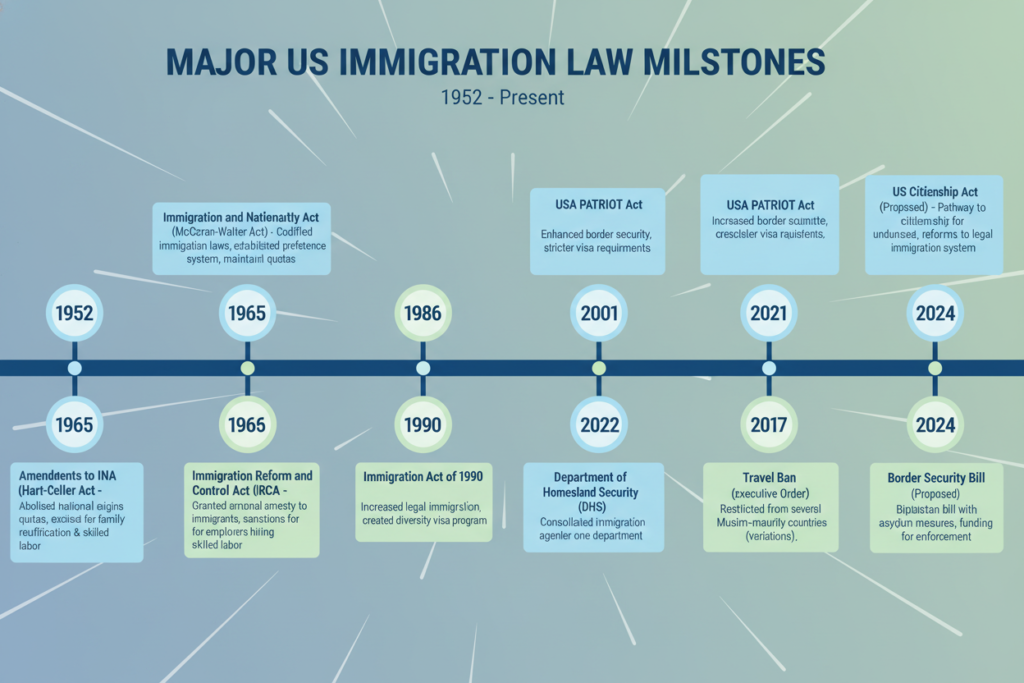
Congress passed the Immigration and Nationality Act in 1952. This law, also called the INA, established the basic structure still used today. Major amendments in 1965, 1986, and 1990 shaped the current system.
The INA sets numerical limits on immigration. Each year, the United States admits approximately one million people as permanent residents. Additional millions enter as temporary visitors, students, and workers.
Numerical Limits and Preference System
The preference system ranks applicants by category. Family-based immigration includes four preference categories. Employment-based immigration includes five preference categories. Each category receives an annual quota.
Per-country limits prevent any single nation from dominating immigration numbers. No country can receive more than seven percent of total immigrant visas per year. This creates backlogs for applicants from high-demand countries like India, China, Mexico, and the Philippines.
| Immigration Category | Annual Limit | Current Wait Time | Per-Country Cap |
| Family-based (all preferences) | 226,000 visas | 2-20+ years | 7% maximum |
| Employment-based (all preferences) | 140,000 visas | 1-15+ years | 7% maximum |
| Diversity Visa Lottery | 55,000 visas | Annual lottery | No single country >7% |
| Refugee Admissions | Varies by Presidential determination | 18-24 months average | No cap |
Navigate Immigration Laws Without Confusion
Understanding the immigration system is just the first step. Get clear, actionable guidance designed for your specific path—whether you’re pursuing a visa, green card, or citizenship. Join thousands who’ve successfully navigated this complex journey with expert resources.
Visa Categories: Temporary and Permanent Options
The United States offers dozens of visa types, each designed for specific purposes. Understanding which category fits your situation is the crucial first step in any immigration journey.
Nonimmigrant Visas for Temporary Stay
Nonimmigrant visas allow temporary entry for specific activities. These visas include strict time limits and activity restrictions. Violating these conditions can result in deportation and future entry bans.
Tourist and Business Visas
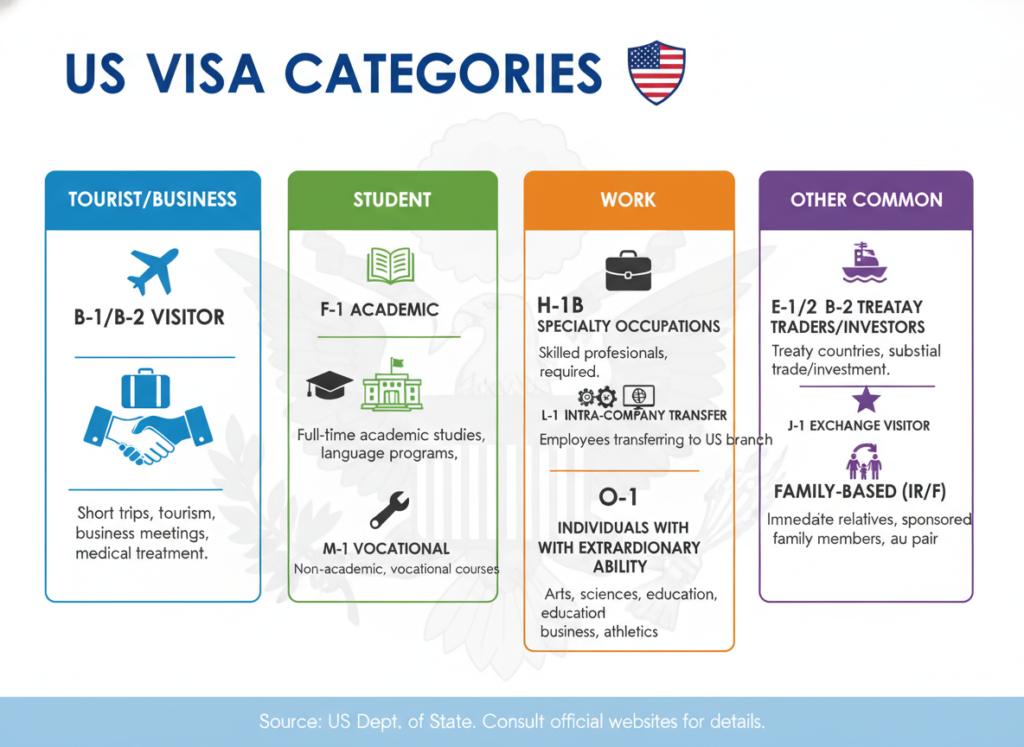
The B-1/B-2 visa category serves tourists and business visitors. B-2 covers tourism, medical treatment, and visiting family members. B-1 allows business meetings, conferences, and contract negotiations. Visitors typically receive authorization for six months per entry.
Travelers from many countries can enter under the Visa Waiver Program instead. This program allows 90-day stays without a formal visa. Citizens of 40 countries qualify, including most European nations, Japan, and Australia.
Student Visas
Students pursue education on F-1 or M-1 visas. F-1 covers academic study at colleges, universities, and language schools. M-1 applies to vocational training programs. Students can work on campus for limited hours and may qualify for practical training after graduation.
The duration of status allows students to remain throughout their program. They must maintain full-time enrollment and make normal academic progress. Dropping below full-time status can trigger deportation proceedings.
Work Visas
Employment-based temporary visas serve different worker categories. The H-1B visa brings specialty occupation workers for up to six years. Technology companies, hospitals, and universities heavily use this category. The annual cap of 85,000 creates intense competition each year.
L-1 visas transfer employees within multinational companies. E-2 visas support treaty investors who operate businesses. O-1 visas recognize individuals with extraordinary ability in sciences, arts, or business. Each category has specific requirements and time limits.
H-1B Specialty Occupation
Requires bachelor’s degree or higher in specific field. Common for technology, engineering, and healthcare professionals.
- 65,000 regular cap annually
- 20,000 advanced degree cap
- Initial 3-year period, extendable to 6 years
- Dual intent allowed (can pursue green card)
L-1 Intracompany Transfer
For employees transferring from foreign office to US office of same company.
- L-1A for managers and executives
- L-1B for specialized knowledge workers
- Up to 7 years for L-1A, 5 years for L-1B
- No annual cap or lottery
O-1 Extraordinary Ability
For individuals with exceptional talent in sciences, arts, education, business, or athletics.
- Requires extensive documentation of achievements
- Initial approval up to 3 years
- Unlimited extensions in 1-year increments
- No annual numerical limit
Immigrant Visas for Permanent Residence
Immigrant visas provide lawful permanent residence, commonly called a green card. Green card holders can live and work anywhere in the United States indefinitely. After five years (or three years for spouses of citizens), they may apply for citizenship.
Most immigrant visas fall into family-based or employment-based categories. Each category operates under the preference system with annual numerical limits. Processing times vary from one year to over two decades depending on the category and country of birth.
Immediate Relative Category
Immediate relatives of US citizens face no numerical limits. This category includes spouses, unmarried children under 21, and parents of adult citizens. Processing typically takes 12 to 18 months. This represents the fastest path to a green card for most families.
Citizens can sponsor these family members without waiting for quota availability. The relationship must be proven through marriage certificates, birth certificates, or adoption papers. USCIS carefully scrutinizes marriages to prevent fraud.
Family Preference Categories
Other family relationships fall into preference categories with annual limits. The first preference covers unmarried adult children of citizens. The second preference includes spouses and children of permanent residents. The third and fourth preferences cover married children and siblings of citizens.
Wait times in these categories extend for years. Filipino citizens waiting for sibling sponsorship face delays exceeding 20 years. Mexican nationals in several categories wait over a decade. Per-country limits create these extreme backlogs.
| Visa Category | Who Qualifies | Annual Limit | Typical Wait Time |
| Immediate Relatives | Spouses, children under 21, parents of US citizens | Unlimited | 12-18 months |
| F1 – First Preference | Unmarried adult children of US citizens | 23,400 | 7-22 years |
| F2 – Second Preference | Spouses and children of permanent residents | 114,200 | 2-8 years |
| F3 – Third Preference | Married children of US citizens | 23,400 | 10-22 years |
| F4 – Fourth Preference | Siblings of adult US citizens | 65,000 | 13-24 years |
Employment-Based Immigration
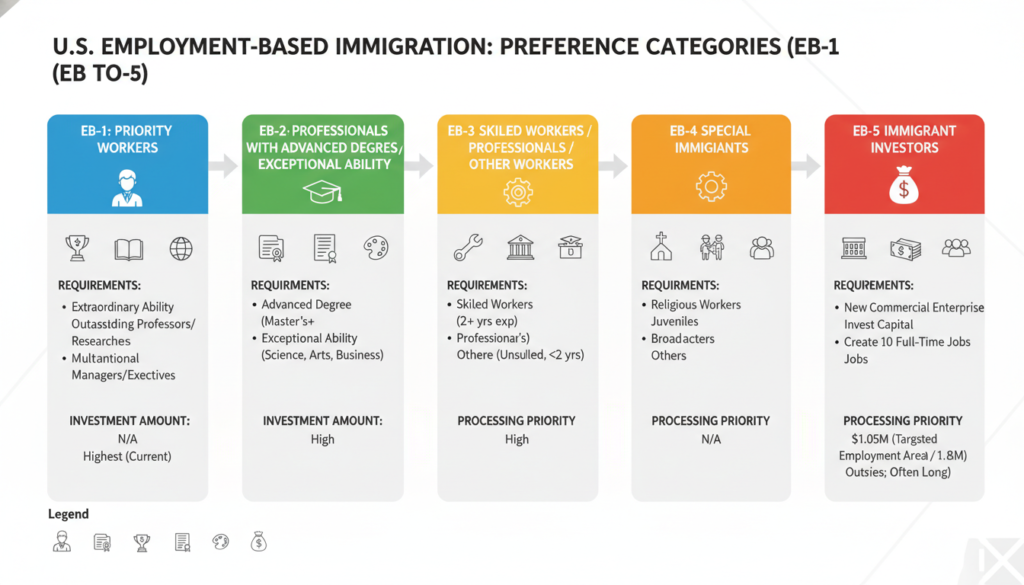
Five employment preferences offer green cards to workers. The first preference (EB-1) serves individuals with extraordinary ability, outstanding professors, and multinational executives. This category faces minimal wait times for most countries.
The second preference (EB-2) requires advanced degrees or exceptional ability. The third preference (EB-3) covers skilled workers, professionals, and other workers. Both categories experience significant backlogs, especially for applicants born in India and China.
The fourth preference serves special immigrants like religious workers. The fifth preference (EB-5) provides green cards to investors who create jobs. EB-5 requires investment of at least $800,000 in targeted employment areas or $1,050,000 in other areas.
Get Step-by-Step Guidance for Your Visa Path
Every visa category has unique requirements, forms, and timelines. Avoid costly mistakes and application delays. The Immigration Navigator PRO provides detailed instructions for your specific situation—from work visas to family sponsorship. Learn what to file, when to file it, and how to prepare for your interview.
Green Card Pathways: Routes to Permanent Residence
A green card grants lawful permanent residence in the United States. Holders can live and work anywhere in the country without time limits. This status provides a path to citizenship and protects against deportation except in specific circumstances.
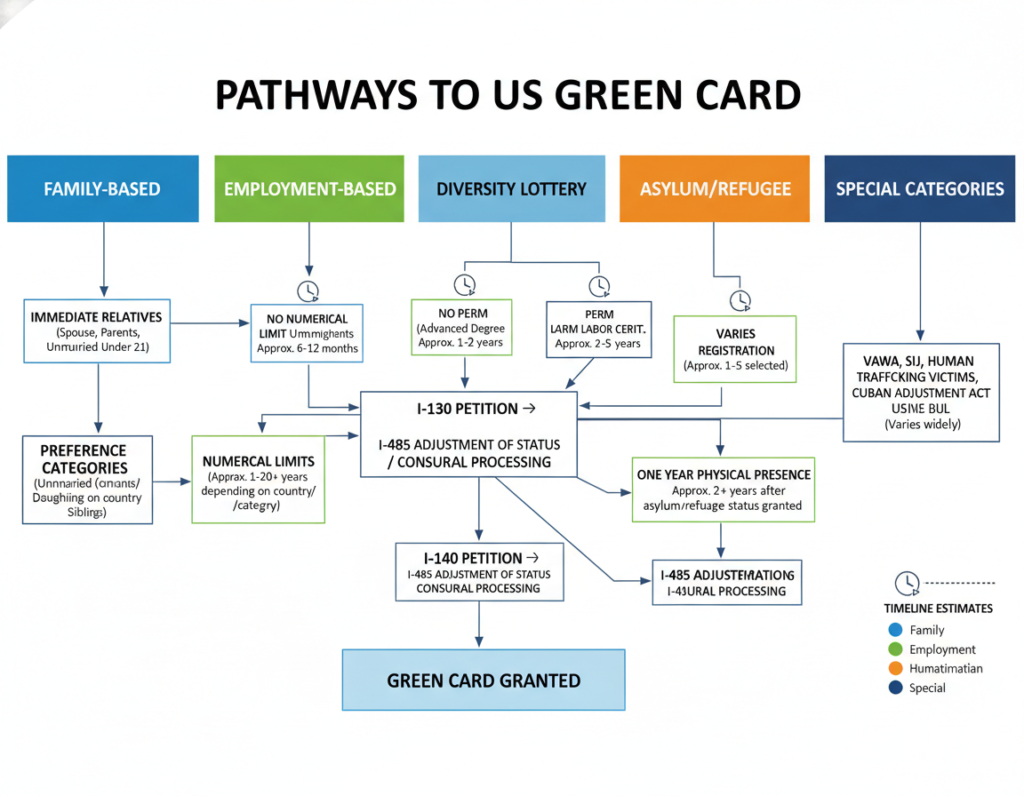
Family-Based Green Cards
Family sponsorship remains the most common route to permanent residence. US citizens and permanent residents can sponsor certain family members. The relationship determines the category, which affects processing time and requirements.
Citizens enjoy broader sponsorship rights than permanent residents. Citizens can sponsor spouses, children, parents, and siblings. Permanent residents can only sponsor spouses and unmarried children. This difference significantly impacts family immigration planning.
The Petition Process
Family sponsorship begins with Form I-130, Petition for Alien Relative. The US sponsor files this form with USCIS along with relationship evidence and fees. USCIS reviews the petition to verify the family relationship and sponsor’s status.
Approval doesn’t immediately grant a green card. For preference categories, approved petitioners must wait for visa availability. The State Department publishes monthly visa bulletins showing current priority dates. When a priority date becomes current, the applicant can proceed to the next step.
Applicants already in the United States may file Form I-485, Application to Register Permanent Residence. This adjustment of status process allows people to remain in the country during processing. Applicants abroad instead complete consular processing at a US embassy or consulate.
Affidavit of Support Requirement
All family-based petitioners must submit Form I-864, Affidavit of Support. This legally enforceable contract requires sponsors to maintain the immigrant at 125 percent of federal poverty guidelines. The obligation continues until the immigrant becomes a citizen, works 40 qualifying quarters, or permanently leaves the United States.
Sponsors who don’t meet income requirements can add joint sponsors or household members. Assets can substitute for income at a five-to-one ratio. USCIS strictly enforces these requirements to prevent public charge issues.
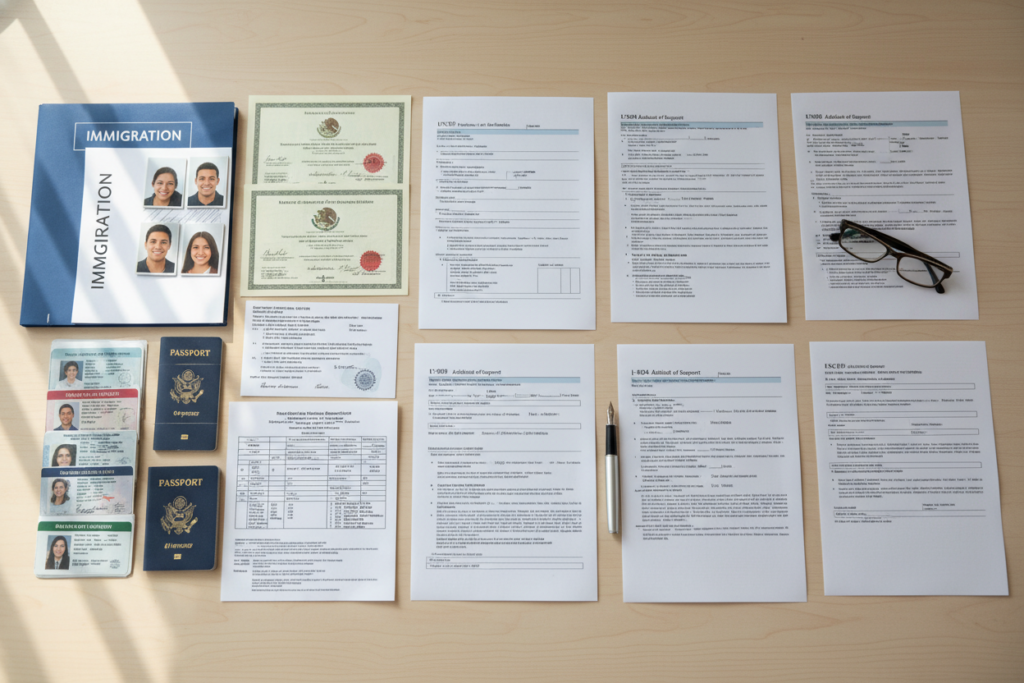
Documents Required for Family Sponsorship
- Form I-130 petition with filing fee
- Proof of sponsor’s US citizenship or permanent residence
- Birth certificates, marriage certificates, or other relationship evidence
- Form I-864 Affidavit of Support with tax returns and income proof
- Passport-style photos meeting USCIS specifications
- Medical examination results from approved civil surgeon
- Police certificates from countries of residence
- Form I-485 or DS-260 depending on adjustment or consular processing
Employment-Based Green Cards
Employment sponsorship provides another major green card pathway. US employers petition for foreign workers they want to employ permanently. The process typically requires labor certification proving no qualified US workers are available.
PERM Labor Certification
Most employment-based cases require PERM labor certification. Employers must test the US labor market by advertising the position. They must document recruitment efforts and explain why US applicants weren’t qualified.
The Department of Labor reviews PERM applications. Approval confirms the position’s prevailing wage and recruitment efforts met requirements. The employer then files Form I-140, Immigrant Petition for Alien Worker, with USCIS.
EB-1 cases skip labor certification. This preference recognizes extraordinary ability, outstanding professors and researchers, and multinational executives or managers. EB-1 applicants can self-petition without employer sponsorship in the extraordinary ability subcategory.
National Interest Waiver
The national interest waiver exempts certain EB-2 applicants from labor certification. This option suits those whose work benefits the United States. Common beneficiaries include researchers, entrepreneurs, and professionals in critical fields.
Applicants must prove their endeavor has substantial merit and national importance. They must show they’re well-positioned to advance the endeavor. Finally, they must demonstrate that waiving job offer and labor certification requirements benefits the United States.
Success Story: Employment-Based Green Card
“The employment-based process felt impossible at first. My employer started PERM in 2019, and I finally got my green card in 2023. Understanding the labor certification requirements and priority date system made the wait bearable. Having clear guidance on what documents to keep and when to expect each step reduced my stress significantly.”
Diversity Visa Lottery
The Diversity Immigrant Visa Program, commonly called the green card lottery, randomly selects 55,000 immigrants per year. Applicants must be from countries with low immigration rates to the United States. Countries sending more than 50,000 immigrants in the previous five years are ineligible.
Registration occurs online during a brief period each October. Applicants must meet education or work experience requirements. High school graduation or two years of qualifying work experience within the past five years satisfies this threshold.
Selection doesn’t guarantee a visa. Winners must complete processing and pass security checks within the fiscal year. Roughly 100,000 people receive selection notices, anticipating that many won’t complete the process. Those who proceed face the same interviews and background checks as other immigrants.
Special Categories and Protections
Several special programs provide green cards outside the normal preference system. These categories address unique situations and humanitarian concerns.
Asylum and Refugee Status
Refugees apply for protection from outside the United States. Asylum seekers apply after arrival at the border or from within the country. Both programs protect people fleeing persecution based on race, religion, nationality, political opinion, or membership in a particular social group.
Asylum applicants must apply within one year of US entry unless circumstances change or extraordinary circumstances prevented timely filing. Approval grants work authorization immediately. After one year of asylee status, individuals can apply for a green card.
Refugee admissions follow a presidential determination setting annual limits. Processing occurs overseas through USCIS refugee officers. Approved refugees receive travel documents and enter as permanent residents upon arrival.
VAWA Self-Petitions
The Violence Against Women Act allows abuse victims to self-petition for green cards. Spouses, children, and parents abused by US citizens or permanent residents qualify. Self-petitioning removes the abuser’s control over the victim’s immigration status.
VAWA applicants don’t need the abuser’s cooperation or knowledge. They must prove the relationship, the abuser’s status, and the abuse through credible evidence. Police reports, medical records, and affidavits support these claims.
Avoid $10,000+ in Legal Fees for Standard Cases
Green card applications involve complex forms, strict deadlines, and precise documentation requirements. One mistake can delay your case by months or result in denial. Learn exactly what evidence to gather, how to prepare for your interview, and when each form is due. Join 2,847+ immigrants who successfully navigated their green card journey with expert guidance.
Path to Citizenship: Naturalization Process
Naturalization transforms lawful permanent residents into US citizens. This process grants voting rights, eligibility for federal jobs, and protection from deportation. Citizens can also sponsor more family members and travel with a US passport.
Eligibility Requirements
Most permanent residents must wait five years before applying for naturalization. Spouses of US citizens can apply after three years. The continuous residence requirement demands physical presence in the United States for at least half the required period.
Applicants must demonstrate good moral character. USCIS reviews criminal history, tax compliance, and immigration violations. Certain crimes permanently bar naturalization. Others create temporary bars of varying lengths.
English language proficiency is required for most applicants. Those over 50 with 20 years of permanent residence, or over 55 with 15 years, can take the civics test in their native language. People over 65 with 20 years of residence receive simplified civics test content.
Physical Presence and Continuous Residence
Physical presence requires at least 30 months in the United States during the five-year period (or 18 months for three-year rule cases). Continuous residence means maintaining permanent resident status without abandoning it.
Trips abroad longer than six months raise questions about continuous residence. Trips over one year automatically break continuous residence unless the applicant obtained a reentry permit before departure. Even shorter trips may disrupt residence if they occur frequently.
Standard 5-Year Rule
The general path for most permanent residents seeking citizenship.
- 5 years as lawful permanent resident
- 30 months physical presence in US
- No trips abroad exceeding 6 months
- Good moral character throughout period
3-Year Spousal Rule
Accelerated timeline for spouses of US citizens with special requirements.
- 3 years married to and living with US citizen spouse
- 18 months physical presence in US
- Spouse must be US citizen for entire 3 years
- Marriage must remain valid at oath ceremony
Military Service Path
Special provisions for those serving in the US armed forces.
- 1 year honorable service during peacetime
- No waiting period during designated hostilities
- Expedited processing available
- Family members may qualify for benefits
Special Exemptions
Certain applicants qualify for modified requirements.
- Age 50+ with 20 years residence (language exemption)
- Age 55+ with 15 years residence (language exemption)
- Age 65+ with 20 years residence (easier civics test)
- Disability accommodations for qualifying conditions
The Naturalization Application Process
Naturalization begins with Form N-400, Application for Naturalization. This comprehensive form asks about residence history, employment, travel, family, and moral character. Applicants must disclose all arrests, citations, and legal issues even if charges were dropped or records were expunged.
Filing fees currently total $725, including the application fee and biometrics fee. Fee waivers are available for applicants meeting income guidelines. Reduced fees apply to those with incomes between 150 and 200 percent of federal poverty guidelines.
Biometrics and Interview
USCIS schedules a biometrics appointment after receiving the application. Applicants provide fingerprints, photos, and signatures at a local Application Support Center. These biometrics support FBI background checks.
The naturalization interview occurs several months later. A USCIS officer reviews the application, tests English ability, and administers the civics test. The officer may ask questions about any part of the application or the applicant’s history.
The Civics Test
The civics test covers US history and government. USCIS provides a list of 100 possible questions. Officers ask up to 10 questions during the interview. Applicants must answer six correctly to pass.
Questions cover the Constitution, government structure, rights and responsibilities, American history, and geography. Common topics include the three branches of government, the Bill of Rights, the authors of founding documents, and the reasons colonists came to America.
The English test evaluates reading, writing, and speaking ability. Applicants must read one of three sentences correctly and write one of three sentences correctly. The interview itself demonstrates speaking proficiency.
| Test Component | Format | Passing Requirement | Exemptions Available |
| Civics Test | 10 questions from 100-question pool | Answer 6 out of 10 correctly | Yes – age/residence based |
| English Reading | Read 1 of 3 sentences aloud | Read 1 sentence correctly | Yes – age/residence based |
| English Writing | Write 1 of 3 sentences | Write 1 sentence correctly | Yes – age/residence based |
| English Speaking | Conversation during interview | Demonstrate basic proficiency | Yes – age/residence based |
The Oath of Allegiance
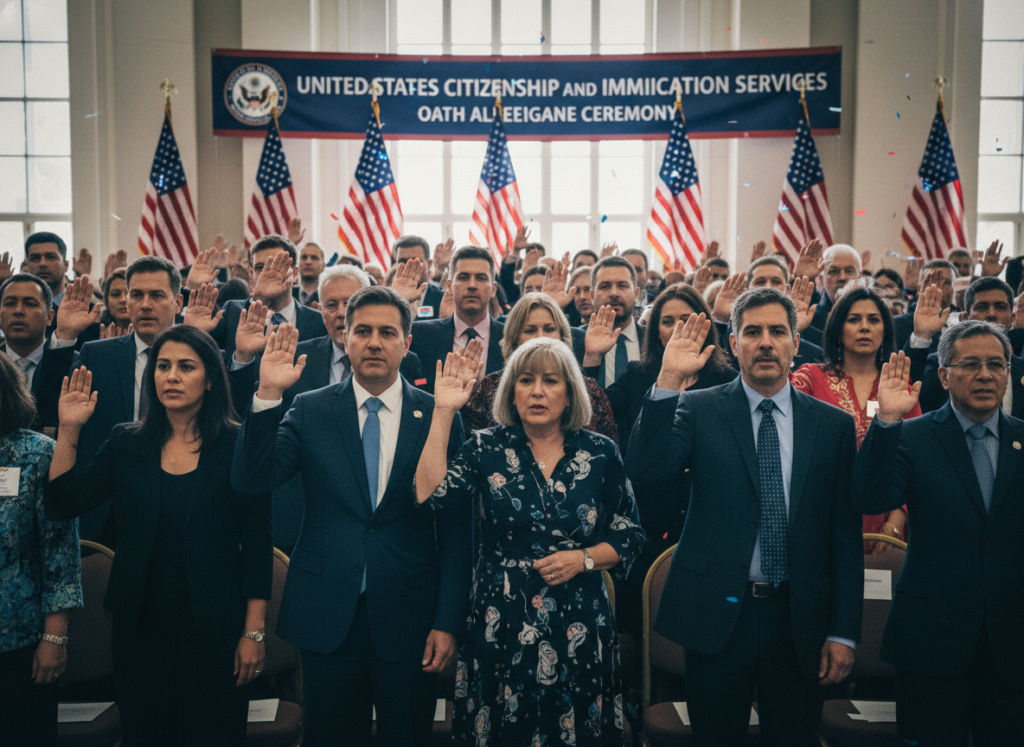
Approved applicants receive a ceremony notice. Naturalization becomes official only after taking the Oath of Allegiance at a ceremony. USCIS and federal courts conduct these ceremonies.
The oath requires renouncing foreign allegiances and promising to support and defend the Constitution. New citizens receive a Certificate of Naturalization at the ceremony. This document proves citizenship and allows applying for a US passport.
Some applicants may take a modified oath due to religious beliefs or other qualifying reasons. These modifications allow omitting the requirement to bear arms on behalf of the United States.
After Naturalization
New citizens should apply for a US passport promptly. The passport serves as citizenship proof and enables international travel under US protection. Citizens should also register to vote if they wish to participate in elections.
Naturalized citizens enjoy nearly all rights of natural-born citizens. The only significant exception is eligibility for President or Vice President, which requires natural-born citizenship. Citizens can sponsor family members under more favorable immigration categories.
Real Experience: Citizenship Journey
“I applied for citizenship after five years as a permanent resident. The N-400 form seemed straightforward until I reached the moral character questions. I had a traffic ticket from three years ago and wasn’t sure if I needed to disclose it. After researching and getting guidance, I included it with an explanation. My interview lasted 20 minutes. The officer was professional and put me at ease. I passed the civics test—knowing how to prepare made all the difference. Taking the oath was the proudest moment of my life.”
Pass Your Citizenship Test with Confidence
The naturalization process involves careful application preparation, civics test study, and interview readiness. Don’t let anxiety or confusion hold you back from this final step. Get comprehensive preparation materials, practice questions, interview tips, and step-by-step N-400 guidance. Everything you need to become a US citizen successfully.
Historical Evolution of Immigration Policy
Understanding current immigration laws in USA requires examining their historical development. Each major law reflects the political, economic, and social conditions of its era. These policies shaped who could enter America and under what conditions.
Early Immigration History
The United States imposed few immigration restrictions before 1875. Open borders allowed millions to arrive during the 19th century. This changed as nativist sentiment grew and economic concerns emerged.
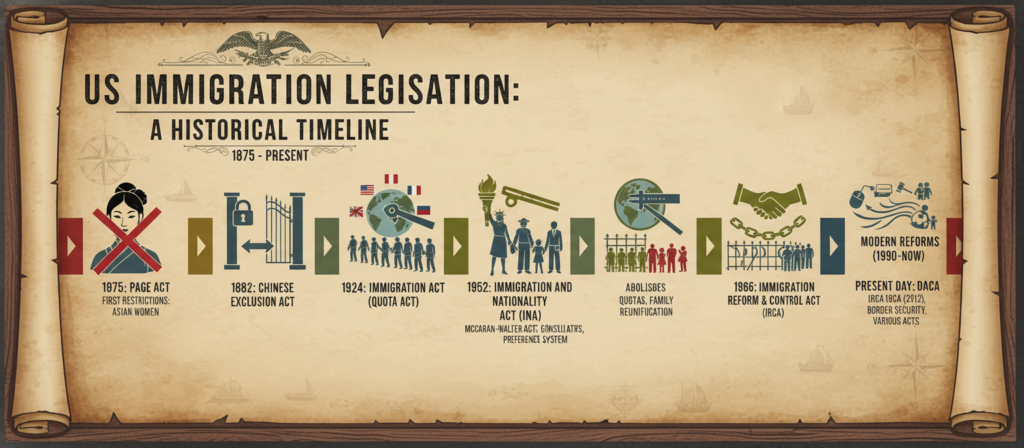
The Page Act of 1875 marked the first federal immigration law. It targeted Asian women suspected of prostitution. The Chinese Exclusion Act of 1882 went further, banning Chinese laborers for ten years. This law established the precedent for race-based immigration restrictions.
The Quota Era
The Immigration Act of 1924 created national-origin quotas. These quotas heavily favored Northern and Western European immigrants while restricting Southern Europeans, Asians, and Africans. The system calculated quotas based on the 1890 census, deliberately preserving America’s ethnic composition.
This quota system remained in place for four decades. It reflected the eugenics movement and racial theories popular in the early 20th century. The law severely limited immigration from most of the world outside Western Europe.
The Immigration and Nationality Act of 1952
The INA of 1952, also called the McCarran-Walter Act, codified immigration law into a single statute. This law maintained national-origin quotas but removed race as a complete bar to immigration. Asian immigrants could naturalize for the first time since exclusion laws began.
The act created the preference system still used today. It prioritized skilled workers and family members of citizens and residents. However, national quotas remained the dominant feature, limiting diversity in immigration patterns.
The 1965 Immigration Act
The Immigration and Nationality Act of 1965 abolished national-origin quotas. This landmark legislation emerged during the civil rights era and reflected changing American values. It established the family-based and employment-based preference system used today.
The law set a per-country limit of 20,000 immigrants per year. It capped total immigration from the Eastern Hemisphere at 170,000 annually. Western Hemisphere immigration faced a cap of 120,000 without per-country limits initially.
These changes dramatically altered immigration patterns. Immigration from Asia, Latin America, and Africa increased significantly. European immigration declined as a percentage of total immigration. The act shaped modern American demographics.
Unintended Consequences
The 1965 Act created new challenges. Per-country limits caused severe backlogs for high-demand countries. Family reunification provisions led to chain migration concerns. The law’s architects didn’t anticipate these developments.
Illegal immigration also increased after 1965. The end of the Bracero Program in 1964 eliminated legal channels for Mexican agricultural workers. Combined with increased enforcement, this created an unauthorized population that grew steadily over decades.
Modern Immigration Reforms
Congress passed major immigration legislation in 1986, 1990, and 1996. Each law attempted to address problems in the system while responding to contemporary concerns.
Immigration Reform and Control Act of 1986
IRCA offered amnesty to approximately 2.7 million undocumented immigrants. Those who had lived in the United States continuously since 1982 could legalize their status. Special provisions covered agricultural workers.
The law also created employer sanctions for hiring unauthorized workers. Employers must verify work authorization through Form I-9. However, enforcement remained inconsistent, and unauthorized employment continued.
Immigration Act of 1990
The 1990 Act increased annual immigration limits to 700,000. It expanded employment-based immigration from 54,000 to 140,000 per year. The diversity visa lottery began under this law to increase immigration from underrepresented countries.
This act created the H-1B visa category for specialty occupation workers. The program initially capped these visas at 65,000 annually. Technology companies heavily utilized this category, leading to demands for increases during the 1990s tech boom.
Illegal Immigration Reform and Immigrant Responsibility Act of 1996
IIRIRA strengthened immigration enforcement significantly. It expanded deportation grounds, limited relief from removal, and increased penalties for immigration violations. The law made it harder to challenge deportation orders in court.
The act created the three-year and ten-year bars for unlawful presence. People who accrue six months of unlawful presence face a three-year bar upon departure. Those with one year or more face a ten-year bar. These provisions still affect millions today.
| Year | Legislation | Major Provisions | Impact |
| 1952 | Immigration and Nationality Act | Codified immigration law, created preference system, maintained quotas | Foundation for modern immigration law |
| 1965 | Hart-Celler Act | Abolished national-origin quotas, established family/employment preferences | Transformed immigration demographics |
| 1986 | IRCA | Amnesty for 2.7 million, employer sanctions, agricultural worker provisions | Largest legalization program in US history |
| 1990 | Immigration Act of 1990 | Increased caps, created H-1B and diversity lottery, expanded employment immigration | Boosted legal immigration levels significantly |
| 1996 | IIRIRA | Unlawful presence bars, expedited removal, increased deportation grounds | Dramatically toughened enforcement |
Recent Policy Changes and Current Landscape
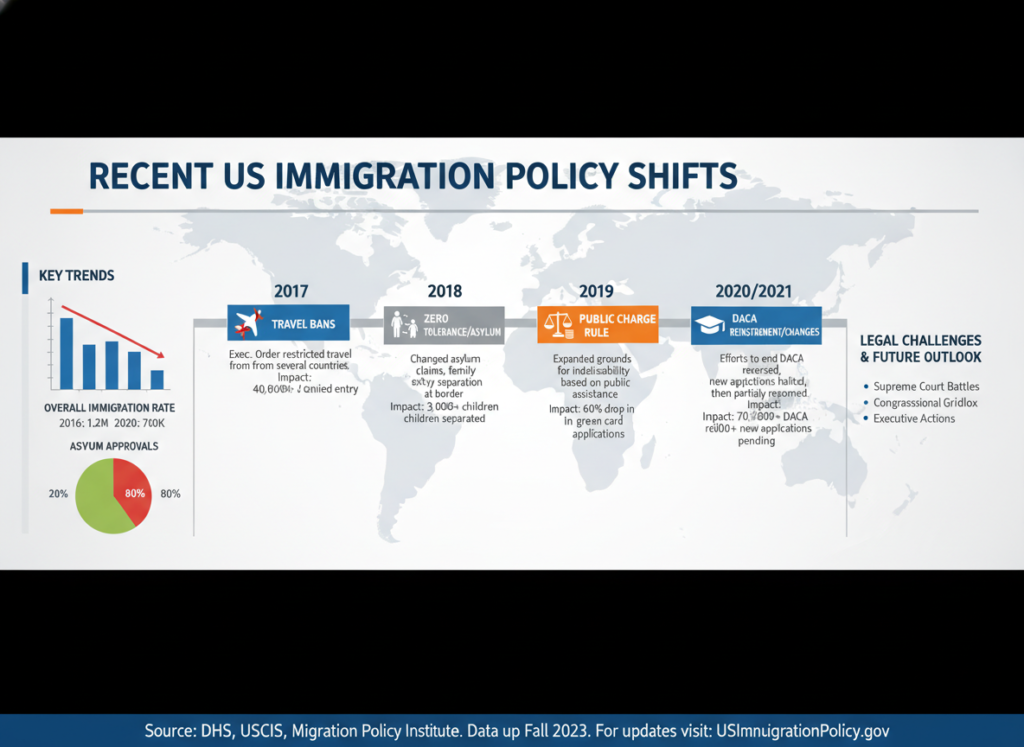
Immigration policy continues evolving through presidential actions, regulatory changes, and court decisions. Recent years have seen significant shifts affecting millions of immigrants and their families.
DACA and Deferred Action Programs
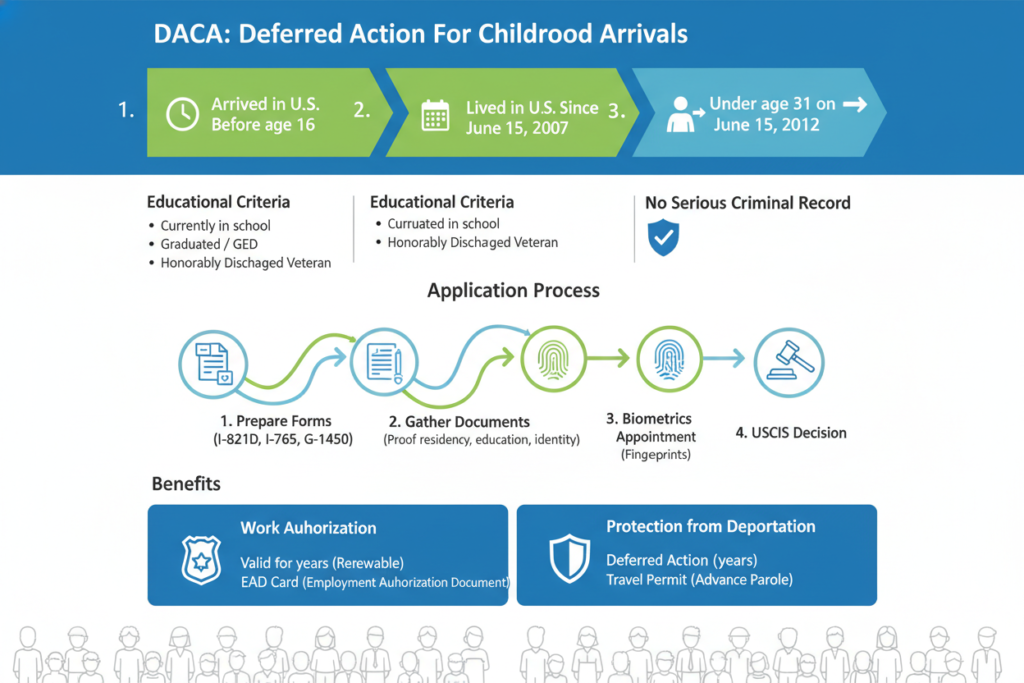
Deferred Action for Childhood Arrivals began in 2012. DACA provides temporary protection from deportation and work authorization for certain individuals brought to the United States as children. Recipients must renew their status every two years.
Over 800,000 people have received DACA protection since the program began. The program faced legal challenges and attempted termination. Courts have kept it alive, but its future remains uncertain. New applications remain blocked pending litigation.
DACA recipients cannot travel freely outside the United States without advance parole. They don’t have a direct path to permanent residence through the program itself. Many DACA holders have lived in the country for decades, knowing no other home.
Eligibility Requirements
DACA applicants must have arrived in the United States before age 16. They must have continuously resided here since June 15, 2007. Arrival before June 15, 2012, is required. Applicants must have been under 31 as of June 15, 2012.
Educational requirements include current school enrollment, high school graduation, GED, or honorable military discharge. No significant criminal history is permitted. Each case undergoes individual review.
Public Charge Rule Changes
The public charge inadmissibility ground has existed for over a century. Recent years saw attempts to expand its definition significantly. The 2019 public charge rule considered use of public benefits like Medicaid, SNAP, and housing assistance in green card decisions.
Courts blocked the expanded rule in 2021. Current policy returns to the pre-2019 interpretation. USCIS primarily considers whether an applicant is likely to become primarily dependent on cash assistance or long-term institutionalization.
The uncertainty created by these changes affected immigrant communities significantly. Many families avoided benefits they legally qualified for out of fear. The policy shifts demonstrate how executive actions can rapidly alter immigration enforcement priorities.
Travel Bans and Country-Specific Restrictions
Presidential proclamations have restricted entry from various countries in recent years. These restrictions affected visa issuance, refugee admissions, and entry of certain nationals. Courts reviewed many of these policies, upholding some while blocking others.
Travel restrictions often created separation for families and disrupted business operations. Students, workers, and family members faced uncertain futures as policies changed. The experience highlighted executive branch power over immigration enforcement.
Asylum Policy Transformations
Asylum procedures have undergone significant changes. The Migrant Protection Protocols, also called Remain in Mexico, required asylum seekers to wait in Mexico during proceedings. This policy ended in 2021 but affected thousands of applicants.
Safe third country agreements attempted to require asylum claims in countries transited before reaching the United States. These agreements faced legal challenges and enforcement difficulties. Changes in asylum procedures continue to emerge through regulation and litigation.
The asylum backlog exceeded 1.9 million cases by 2024. Processing times extended to several years for many applicants. This backlog creates prolonged uncertainty for asylum seekers waiting for their cases to be heard.
Credible Fear Interviews
Asylum seekers arriving at the border undergo credible fear interviews. These interviews determine whether applicants have a significant possibility of establishing asylum eligibility. Those who pass receive a hearing before an immigration judge.
Standards for passing credible fear screenings have fluctuated. Higher standards reduce the number advancing to full hearings. Lower standards allow more applicants to pursue asylum claims. These adjustments significantly impact asylum access.
Major Recent Policy Areas
- DACA renewals and legal challenges affecting Dreamers
- Public charge rule interpretation and benefit usage considerations
- Travel restrictions and country-specific visa processing changes
- Asylum procedure modifications including MPP and safe third country agreements
- H-1B visa lottery reforms and wage-based selection proposals
- EB-5 investment program reauthorization and integrity provisions
- Family separation policies and custody standards at the border
- COVID-19 related entry restrictions and vaccination requirements
- Work authorization timelines and automatic extensions
- Visa bulletin retrogression affecting employment-based applicants
Employment Authorization Changes
Work authorization processing times increased dramatically in recent years. Delays in renewing Employment Authorization Documents left many unable to work legally. Automatic extensions of work authorization helped address this problem.
Certain categories now receive automatic 180-day extensions when timely renewal applications are filed. This prevents employment gaps due to processing delays. However, not all categories qualify for automatic extensions, creating disparities.
Visa Bulletin Retrogression
Employment-based visa availability fluctuates monthly. Retrogression occurs when priority dates move backward, making previously available visas unavailable. This particularly affects applicants from India and China in EB-2 and EB-3 categories.
The 2020 and 2021 fiscal years saw unusual visa availability due to reduced processing during COVID-19. This created a brief window for many employment-based applicants to file adjustment of status applications. Subsequent retrogression trapped many in prolonged waits.
Per-country limits continue causing the most severe backlogs. Indian nationals in the EB-2 category face wait times exceeding 50 years under current quotas. Congress has debated eliminating per-country caps, but legislation hasn’t passed.
Stay Ahead of Policy Changes That Affect You
Immigration policies shift constantly through executive orders, new regulations, and court decisions. What’s allowed today might change tomorrow. Don’t navigate these complexities alone. Get access to regularly updated resources, expert analysis of policy changes, and a supportive community that helps you adapt to new requirements. Protected with our 60-day money-back guarantee.
Join 2,847+ immigrants who successfully navigated their cases
Common Immigration Challenges and Solutions
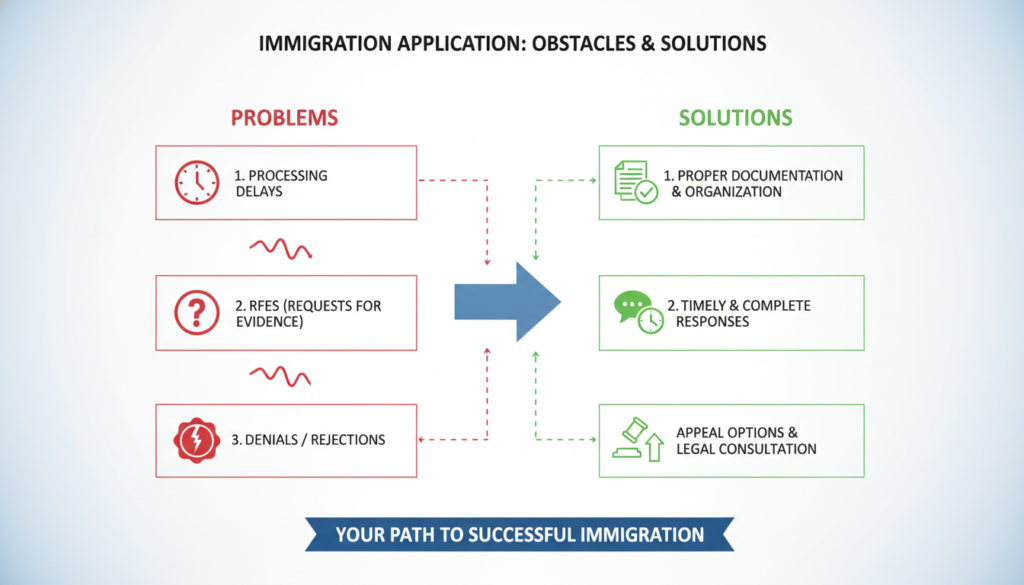
Navigating the immigration system presents numerous obstacles. Understanding common challenges helps applicants prepare and avoid costly mistakes. Many problems have solutions if addressed properly and promptly.
Processing Delays and Backlogs
Processing times vary dramatically by service center and application type. Some applications process in months while others take years. USCIS processing times change frequently based on staffing, resources, and application volume.
Applicants can check case status online using their receipt number. USCIS provides estimated processing times for each form and service center. These estimates help gauge whether a case is experiencing unusual delays.
What to Do About Delays
Contact USCIS if processing exceeds normal timeframes. Service requests can be submitted online when cases fall outside posted processing times. Congressional inquiries sometimes help when other methods fail.
Premium processing is available for certain employment-based petitions. This service guarantees 15-day processing for an additional fee. Not all application types qualify for premium processing.
Mandamus lawsuits represent a last resort for unreasonable delays. These federal court actions require agencies to make decisions on pending applications. They work best when USCIS has violated published timeframes or statutory deadlines.
Request for Evidence and Notices of Intent to Deny
USCIS issues Requests for Evidence when applications lack required documentation or need clarification. RFEs give applicants a chance to strengthen their cases. Responding thoroughly and on time is crucial.
Notices of Intent to Deny warn that USCIS plans to deny an application. NOIDs explain deficiencies and allow a final response. These notices require immediate attention and often benefit from professional help.
Responses must address every issue raised in the RFE or NOID. Simply resubmitting the same evidence usually fails. New evidence, expert opinions, or legal arguments often prove necessary.
Denials and Appeals
Application denials aren’t always final. Multiple options exist depending on the type of denial and the reason. Understanding your rights after denial prevents losing opportunities.
Types of Appeal Options
Administrative appeals go to the Administrative Appeals Office for many USCIS decisions. The Board of Immigration Appeals handles immigration court decisions. Each has different procedures and deadlines.
Motions to reopen ask USCIS to reconsider based on new facts or evidence. Motions to reconsider argue that USCIS incorrectly applied law or policy. These motions must be filed within specific timeframes.
Federal court review is available for some cases. Applicants can challenge denials in federal district court through Administrative Procedure Act claims. Jurisdiction and timing requirements are strict.
Maintaining Status and Avoiding Violations
Status violations create serious immigration consequences. Accruing unlawful presence triggers three-year and ten-year bars. Working without authorization makes applicants ineligible for many benefits.
Students must maintain full-time enrollment except during designated breaks. J-1 exchange visitors must complete program requirements and return home for two years unless they receive waivers. Each visa category has specific requirements.
Common Violations to Avoid
Overstaying a visa creates unlawful presence. Even a single day over can trigger consequences. Some people don’t realize their status expired, especially those who changed status or extended stay.
Unauthorized employment includes working without a valid Employment Authorization Document. It also includes working beyond EAD restrictions or outside permitted employment for visa categories. Even volunteer work can be considered employment in some contexts.
Failing to maintain status requirements specific to your visa category causes problems. Examples include dropping below full-time enrollment as a student or not working for your H-1B sponsoring employer.
Proactive Strategies for Success
- Track all deadlines and set multiple reminders
- Keep copies of every document submitted and received
- Respond to USCIS requests immediately with complete information
- Maintain evidence of continuous residence and physical presence
- Monitor policy changes affecting your case
- Join support communities for emotional and practical guidance
- Document all interactions with USCIS and other agencies
- Seek help early when problems arise rather than waiting
Mistakes That Derail Applications
- Missing deadlines for responses or renewals
- Submitting incomplete or incorrect information
- Failing to disclose arrests, citations, or immigration violations
- Assuming visa status extends automatically
- Working without proper authorization
- Leaving the country without advance parole when required
- Believing misinformation from unqualified sources
- Ignoring USCIS notices or requests
Dealing with Immigration Scams
Immigration fraud preys on vulnerable populations. Scammers promise results they can’t deliver and charge fees for worthless services. Recognizing scams protects you from wasted money and damaged cases.
Common Scam Tactics
Notario fraud particularly affects Spanish-speaking communities. In many Latin American countries, notarios are lawyers with specialized training. In the United States, notaries public only witness signatures and cannot provide legal advice.
Guarantee scams promise visa approval or green cards for fees. No one can guarantee immigration benefits. USCIS makes all final decisions based on law and regulations.
Ghost consultants take money for services they never provide. They may file nothing or submit incorrect forms. Victims often discover problems only when USCIS sends rejection notices or takes no action.
Protecting Yourself
Only licensed attorneys and accredited representatives can provide immigration legal services for a fee. Check credentials with state bar associations or the Executive Office for Immigration Review recognition list.
Avoid anyone who asks you to lie on applications or hide information. This constitutes fraud and can result in permanent bars to immigration benefits. It may also lead to criminal prosecution.
Get everything in writing, including fee agreements and service descriptions. Keep copies of all documents you provide. Never sign blank forms or documents you don’t understand.
Learning From Others’ Experiences
“I almost fell for a scam promising a work permit in 30 days. The person claimed to have connections at USCIS. Something felt wrong, so I researched and found warnings about similar schemes. I’m so glad I didn’t waste my money. Instead, I found reliable resources that explained the actual process and timelines. Taking time to verify information saved me from a huge mistake.”
Practical Tips for Immigration Success
Success in immigration requires preparation, organization, and persistence. These practical strategies help navigate the system more effectively and avoid common pitfalls.
Document Everything
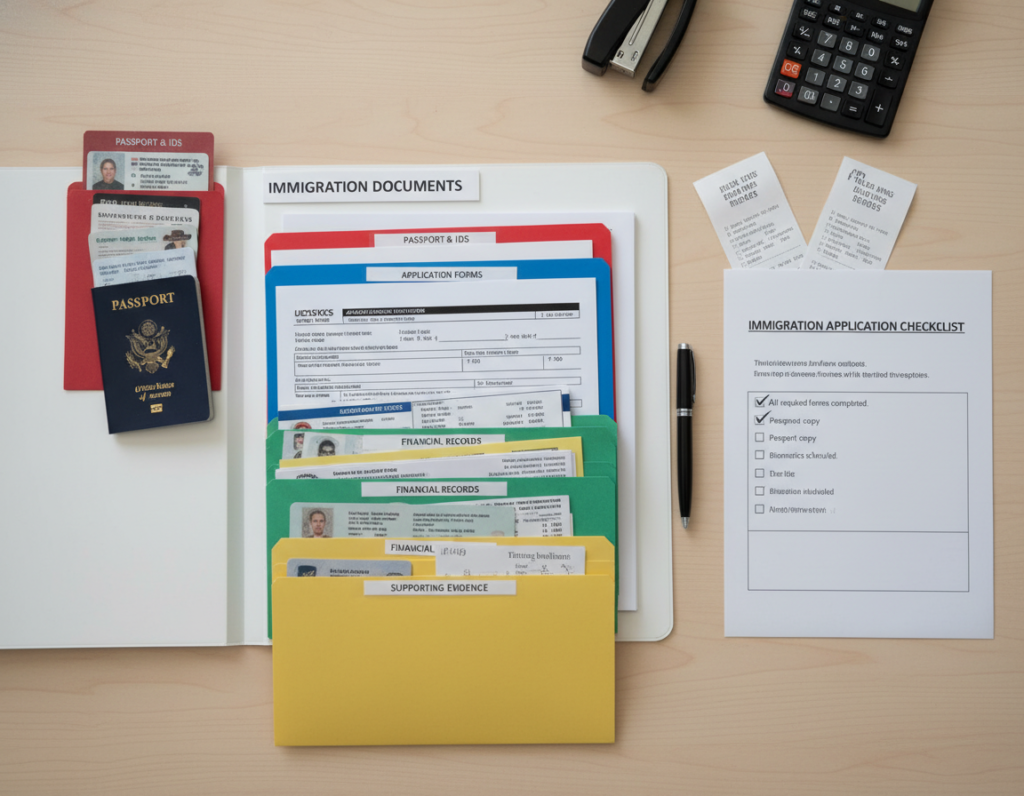
Keep thorough records of your entire immigration journey. Save copies of every form submitted, supporting document, and correspondence with USCIS. Organize files chronologically and by case type.
Take photos or scans of documents before submission. Mail important applications using traceable methods like certified mail or courier services with tracking. Keep proof of mailing and delivery.
Document your physical presence in the United States through various means. Utility bills, bank statements, medical records, school records, and employment documents all prove residence. These records become crucial for green card and citizenship applications.
Creating an Immigration File System
Organize separate folders for each application or petition. Include the original application, all supporting documents, USCIS receipts, and any correspondence. Add notes about important dates and conversations.
Digital backups protect against loss. Scan all documents and store them securely in multiple locations. Cloud storage provides access from anywhere if originals are lost.
Understanding Processing Times
USCIS publishes processing time estimates for each form and service center. These estimates help set realistic expectations. However, actual processing can vary significantly from posted times.
Check the USCIS website regularly for updates. Processing times change based on staffing, policy shifts, and application volume. What took six months last year might take 12 months now.
Build buffer time into your planning. Apply for renewals well before expiration dates. Don’t assume last-minute applications will process in time. Processing delays can leave you without valid status or work authorization.
Preparing for Interviews
Immigration interviews determine the fate of many applications. Preparation reduces anxiety and improves outcomes. Know your case thoroughly and answer questions honestly.
What to Bring
Bring original documents and copies to every interview. This includes passport, birth certificate, marriage certificate, and any documents submitted with your application. USCIS officers may request to see originals.
Prepare updated evidence if circumstances changed since filing. New employment letters, additional proof of relationship, or updated financial documents may strengthen your case.
Arrive early to allow time for security screening. Bring your interview notice and valid government-issued photo identification. Leave unnecessary items at home to speed security checks.
During the Interview
Answer only the questions asked. Don’t volunteer extra information unless it helps your case. If you don’t understand a question, ask the officer to repeat or clarify it.
Tell the truth always. Lying to USCIS constitutes fraud and carries severe consequences including permanent bars to benefits. If you made mistakes in the past, acknowledge them honestly.
Bring an interpreter if you’re not comfortable speaking English. USCIS often provides interpreters for certain interview types. You can also bring your own qualified interpreter.
- Review your entire application before the interview
- Practice answering common questions with a friend
- Dress professionally and arrive early
- Bring all requested documents plus extras
- Stay calm and take your time answering
- Be honest about any issues or mistakes
- Ask for clarification if you don’t understand
- Thank the officer regardless of outcome
Interview Success Strategies
- Arriving late or unprepared
- Arguing with the officer or showing hostility
- Providing inconsistent answers
- Bringing unauthorized people to the interview
- Lying or hiding information
- Volunteering damaging information unnecessarily
- Signing documents you haven’t read carefully
- Leaving without understanding next steps
Interview Mistakes to Avoid
When to Seek Professional Help
Not every case requires an attorney. Straightforward applications with no complications often succeed without legal help. However, certain situations benefit significantly from professional guidance.
Cases That Need Professional Help
Complex cases with criminal history, prior immigration violations, or denials need attorney review. Deportation proceedings always warrant legal representation. The consequences are too severe to navigate alone.
Waiver applications typically require professional help. These applications forgive certain grounds of inadmissibility and require detailed legal arguments. Professional preparation significantly improves approval chances.
Business immigration often involves intricate requirements. Employment-based petitions, particularly PERM labor certification and national interest waivers, benefit from attorney guidance.
Finding Qualified Help
Only hire licensed attorneys or recognized accredited representatives. Check credentials through state bar associations. The Department of Justice maintains a list of accredited representatives authorized to practice immigration law.
Avoid anyone offering guarantees or promises of approval. No one can guarantee USCIS will approve an application. Be wary of unusually low fees or high-pressure sales tactics.
Many organizations offer free or low-cost legal help. Legal aid societies, law school clinics, and nonprofit organizations serve immigrants with limited resources. The American Immigration Lawyers Association provides referrals.
Building a Support Network
Immigration journeys can be isolating and stressful. Connecting with others going through similar experiences provides emotional support and practical advice. Online communities, local organizations, and support groups offer valuable resources.
Share experiences and learn from others who’ve navigated the same paths. Community members often know helpful tips, reliable resources, and what to expect during different processes.
Support networks also provide accountability and encouragement. Immigration processes take time and persistence. Having others who understand the journey makes challenges more manageable.

Join a Community That Understands Your Journey
You don’t have to navigate immigration alone. Connect with thousands who’ve walked this path successfully. Get access to expert resources, step-by-step guides, real success stories, and a supportive community that answers your questions. Everything you need to move forward with confidence, backed by our risk-free 60-day guarantee.
Instant access to 140+ page guide, exclusive podcast, resource website & community
The Future of Immigration Law in the United States
Immigration policy continues evolving through legislation, regulation, and court decisions. Understanding potential changes helps immigrants plan for the future and adapt to new requirements.
Pending Legislative Proposals
Congress regularly considers immigration reform bills. Recent proposals have addressed DACA recipients, employment-based backlogs, and border security. However, comprehensive reform remains politically challenging.
Several bills aim to eliminate per-country caps for employment-based green cards. This change would dramatically reduce wait times for Indian and Chinese nationals. However, it might increase waits for applicants from other countries.
DACA recipients continue seeking a permanent solution. Various bills propose paths to citizenship for Dreamers. Political disagreements have prevented passage despite bipartisan support for some provisions.
Potential System Reforms
Merit-based immigration systems have been proposed as alternatives to family-based preferences. These systems would award points for education, English proficiency, job skills, and other factors. Such changes would fundamentally alter who qualifies for immigration.
Increasing legal immigration levels appears in some proposals. The current numerical limits haven’t significantly increased since 1990 despite population growth. Higher caps could reduce backlogs and processing times.
Technological Changes in Processing
USCIS continues modernizing its systems and processes. Electronic filing has expanded to more form types. Online accounts allow applicants to track cases, receive notices, and respond to requests digitally.
Biometric screening technology improves security and efficiency. Facial recognition and other biometric tools streamline identity verification. However, these technologies also raise privacy and accuracy concerns.
Artificial intelligence may play growing roles in application processing. AI could review documents, flag potential issues, and even make preliminary determinations. Human officers would still make final decisions on most cases.
Demographic and Economic Factors
America’s aging population creates workforce needs that immigration helps address. Many industries face labor shortages that immigrant workers fill. These economic realities influence immigration policy debates.
Changing origin countries shift immigration patterns. Asian immigration has grown significantly while European immigration declined. These demographic changes affect everything from language services to cultural programs.
Climate change may create new migration pressures in coming decades. Rising sea levels, extreme weather, and resource scarcity could displace millions globally. How the United States responds to climate migration remains uncertain.
Enforcement and Border Security
Border security technology advances constantly. Surveillance systems, drones, and sensors supplement traditional enforcement. Virtual walls and enhanced processing facilities represent newer approaches.
Interior enforcement priorities shift with administrations. Some prioritize removing criminals and security threats. Others cast wider enforcement nets. These priorities determine who faces deportation risk.
Cooperation with local law enforcement varies by jurisdiction. Some localities actively assist immigration enforcement. Others limit cooperation through sanctuary policies. These differences create patchwork enforcement across the country.

Court Decisions Shaping Policy
Federal courts play significant roles in immigration law. Supreme Court decisions can invalidate policies or uphold executive authority. Lower courts issue injunctions that block or modify enforcement.
Recent cases addressed travel bans, DACA, asylum procedures, and public charge rules. These decisions demonstrate judicial checks on executive immigration power. Future court compositions will influence immigration jurisprudence.
The administrative law framework governing immigration continues evolving. Questions about agency deference, rulemaking procedures, and judicial review standards affect how policies develop and face challenges.
Moving Forward with Your Immigration Journey
Understanding immigration laws in USA empowers you to make informed decisions about your future. This comprehensive guide covered visa categories, green card pathways, citizenship requirements, historical context, and recent policy changes.
The immigration system presents challenges, but millions successfully navigate it each year. Preparation, organization, and accurate information make the difference between success and frustration. Whether you’re seeking temporary status or permanent residence, knowing the requirements and procedures puts you on the right path.
Immigration journeys take time and persistence. Processing delays, policy changes, and unexpected obstacles test patience and resolve. Remember that setbacks don’t mean failure. Many successful immigrants faced denials, delays, or complications before achieving their goals.
Stay informed about changes affecting your case. Immigration policy evolves through legislation, regulations, and court decisions. What’s true today might change tomorrow. Reliable resources help you adapt to new requirements and opportunities.
Your immigration success depends on accurate information and proper preparation. Understanding the system, following requirements carefully, and seeking help when needed maximizes your chances of approval. The path may be long, but the destination offers security, opportunity, and the chance to build your future in the United States.
Take control of your immigration journey today. Equip yourself with the knowledge and resources needed to navigate this complex system successfully. Join thousands who’ve transformed confusion into clarity and fear into confidence.
Start Your Immigration Journey with Confidence
Don’t let confusion, fear, or misinformation hold you back. Get the Immigration Navigator PRO complete system: 140+ page detailed guide, exclusive podcast analysis, constantly updated resource website, supportive community network, and bonus materials. Everything you need to navigate visa applications, green cards, citizenship, and policy changes successfully. Valued at $599, yours today for just $47 with our risk-free 60-day money-back guarantee.
Join 2,847+ families who successfully navigated their immigration cases
100% Risk-Free • Instant Digital Access • 60-Day Money-Back Guarantee